September 14, 2026
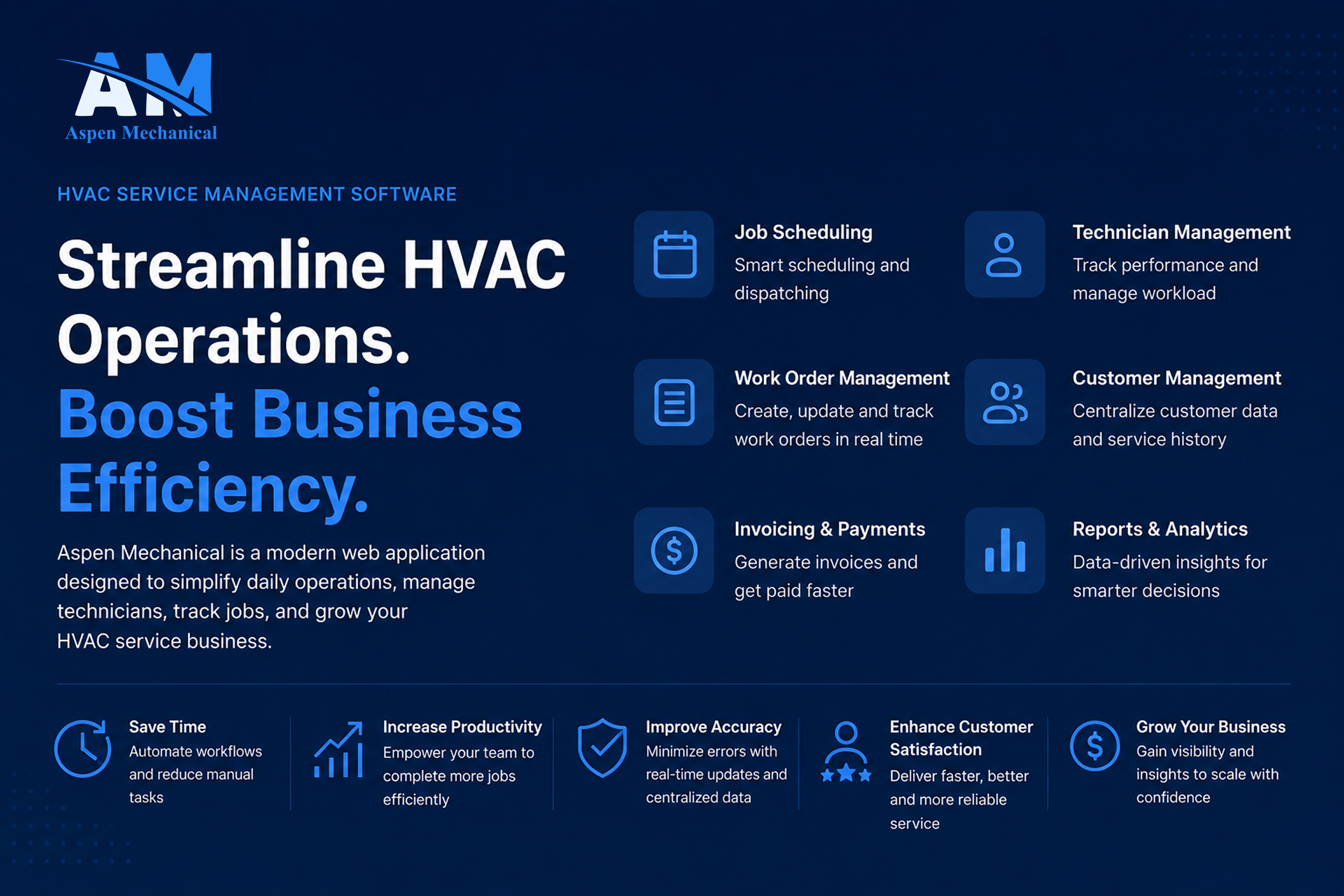
The HVAC industry has evolved significantly over the past decade. As service businesses expand, managing technicians, work orders, customer records, invoices, and scheduling through spreadsheets or disconnected tools becomes increasingly inefficient. Modern HVAC companies require centralized digital solutions that help teams operate faster, reduce administrative overhead, and deliver exceptional customer experiences.
This is where HVAC Service Management Software plays a critical role.
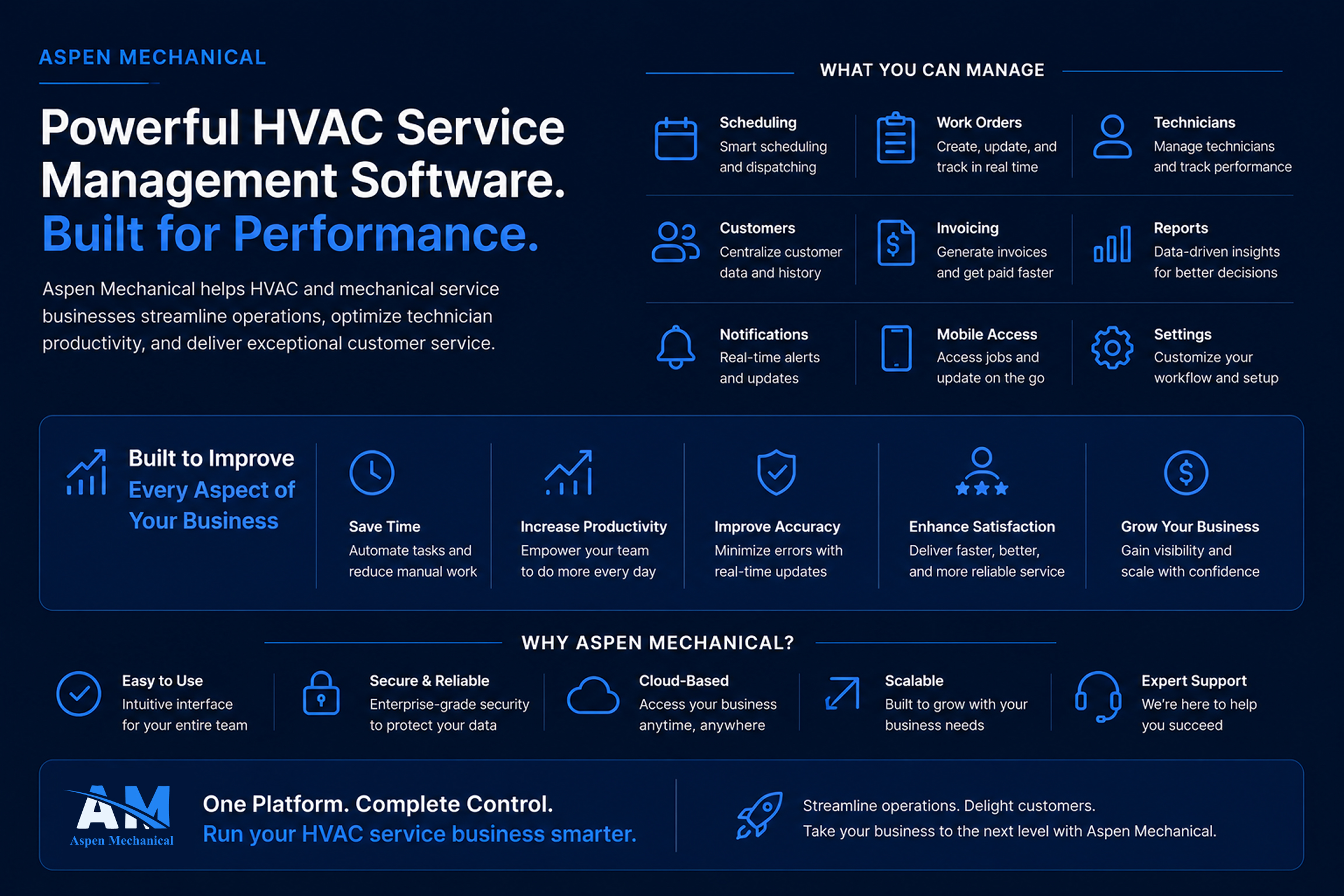
Aspen Mechanical was designed as a modern Field Service Management (FSM) platform that helps HVAC and mechanical service businesses streamline operations, improve workforce coordination, and gain real-time visibility across service activities. Through strategic UI/UX design, the platform transforms complex operational workflows into a simple and intuitive digital experience.
This case study explores how user-centered product design can improve efficiency, productivity, and business performance within the HVAC industry.
Many HVAC companies face similar operational challenges as they grow:
When multiple technicians, service requests, and customer accounts are managed across different systems, operational inefficiencies quickly increase. Modern field service management platforms address these issues by centralizing scheduling, dispatching, work orders, invoicing, and customer communication into a single ecosystem.
Without a streamlined workflow, businesses often experience slower response times, reduced productivity, and lower customer satisfaction.
Before designing Aspen Mechanical, the primary goal was to understand how HVAC service companies operate on a daily basis.
Research revealed that service managers spend a significant amount of time coordinating technicians, monitoring job progress, managing customer requests, and handling administrative processes. Meanwhile, technicians need instant access to service history, work orders, customer information, and job details while in the field.
Successful HVAC service software must bridge the gap between office operations and field execution while maintaining simplicity for every user role. Real-time access to customer history, work orders, and operational data can significantly improve efficiency and first-time resolution rates.
These insights became the foundation of the Aspen Mechanical product strategy.
The design process focused on creating a platform that feels intuitive, scalable, and efficient for service businesses of all sizes.
Every feature was designed around real-world workflows rather than software complexity.
One of the biggest challenges in field service management software is balancing functionality with usability.
HVAC businesses require powerful operational tools, but overwhelming users with excessive information can reduce productivity.
To solve this challenge, Aspen Mechanical uses:
Critical information is prioritized within the dashboard, helping users focus on the most important tasks first.
The application organizes scheduling, customers, work orders, invoices, and reporting into intuitive categories that reduce cognitive load.
Business metrics, revenue data, technician performance, and operational insights are presented through easy-to-understand visualizations that support faster decision-making.
Every screen was designed to reduce clicks, eliminate unnecessary steps, and improve task completion efficiency.
This approach ensures users spend less time navigating software and more time managing their business.
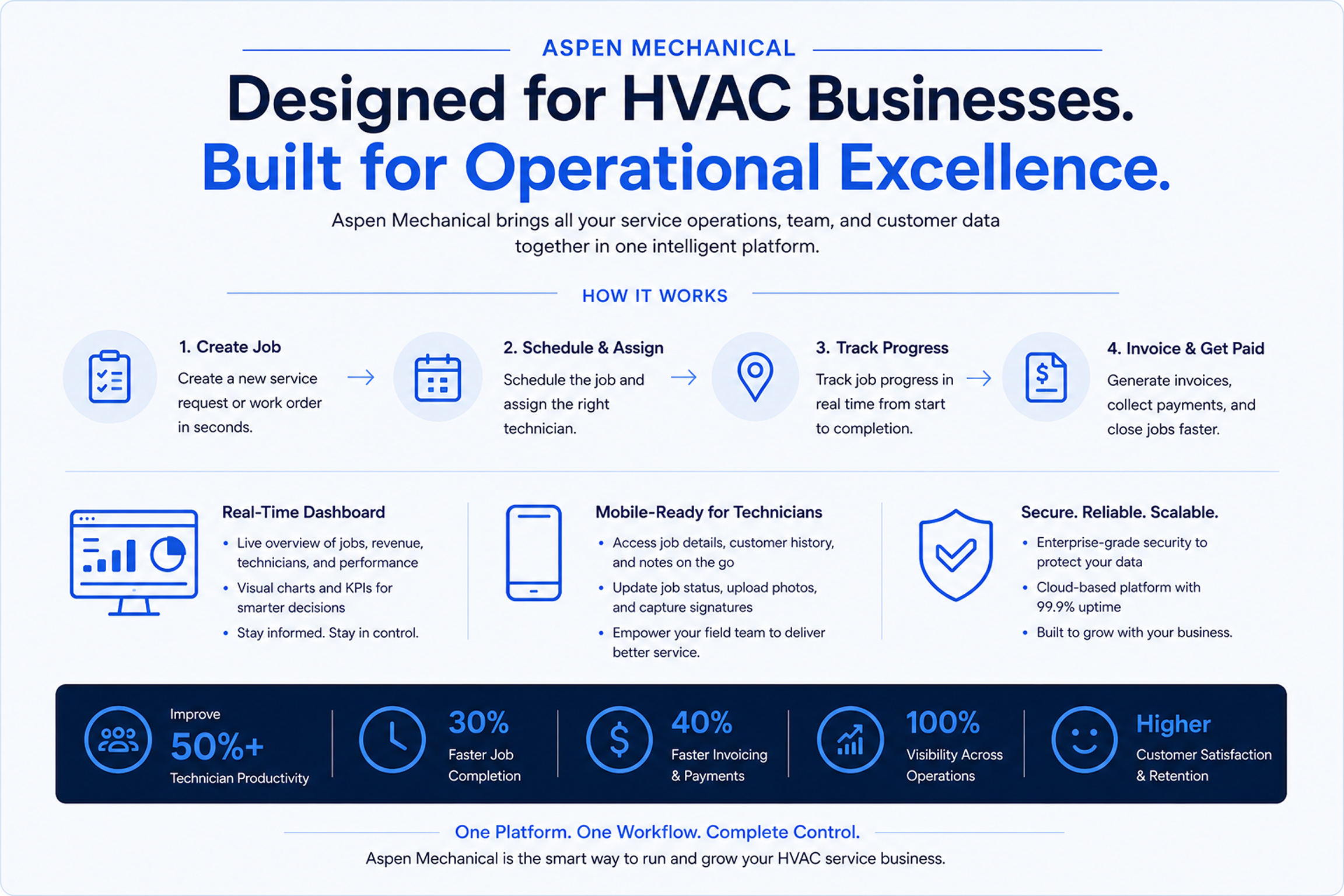
Aspen Mechanical combines multiple operational systems into one centralized platform.
Managing field technicians efficiently is essential for service delivery.
The platform enables businesses to:
Skills-based technician allocation and intelligent scheduling help ensure the right technician is assigned to the right job.
Work orders serve as the operational backbone of HVAC businesses.
The platform simplifies:
By digitizing work orders, businesses reduce paperwork while improving visibility across service operations. Mobile work orders and real-time updates allow technicians and office teams to stay synchronized throughout the service lifecycle.
Customer experience is often the biggest differentiator in service industries.
Aspen Mechanical centralizes:
When technicians have immediate access to customer history and equipment records, they can provide more informed and efficient service.
Data-driven decision-making is essential for growing service businesses.
The platform provides visibility into:
Advanced reporting tools help managers identify opportunities for optimization while supporting long-term business growth.
As SaaS products evolve, maintaining consistency becomes increasingly important.
To support future product expansion, a scalable design system was developed that includes:
This system accelerates future product development while ensuring a cohesive user experience across the entire platform.
Effective UX design delivers measurable business value.
For HVAC service businesses, well-designed field service management software can help:
Industry research consistently shows that field service management platforms improve scheduling efficiency, communication, operational visibility, and customer service outcomes for HVAC organizations.
When users can complete tasks faster and with fewer errors, the entire business benefits.
Designing Aspen Mechanical reinforced several important product design principles:
Technology should adapt to users, not force users to adapt to technology.
Even complex enterprise software can feel intuitive when information is structured effectively.
Dashboards should help users make decisions rather than simply display information.
A strong design system prevents future product growth from creating inconsistency.

Aspen Mechanical demonstrates how strategic UI/UX design can transform field service operations into a streamlined digital experience. By combining user-centered workflows, intuitive dashboard design, and scalable product systems, the platform empowers HVAC businesses to manage operations more efficiently while delivering better customer experiences.
As the HVAC industry continues adopting digital tools, businesses that invest in modern Field Service Management Software, HVAC Service Management Platforms, and customer-focused product design will be better positioned to improve operational performance, increase service quality, and scale sustainably in an increasingly competitive market.