September 14, 2026
The roofing industry has become increasingly competitive, requiring contractors and roofing companies to manage projects, customer relationships, scheduling, estimates, financial operations, and field teams more efficiently than ever before.
As businesses grow, relying on spreadsheets, paper-based workflows, and disconnected software often leads to project delays, communication gaps, administrative inefficiencies, and reduced profitability.
This is where modern Roofing Business Management Software plays a critical role.
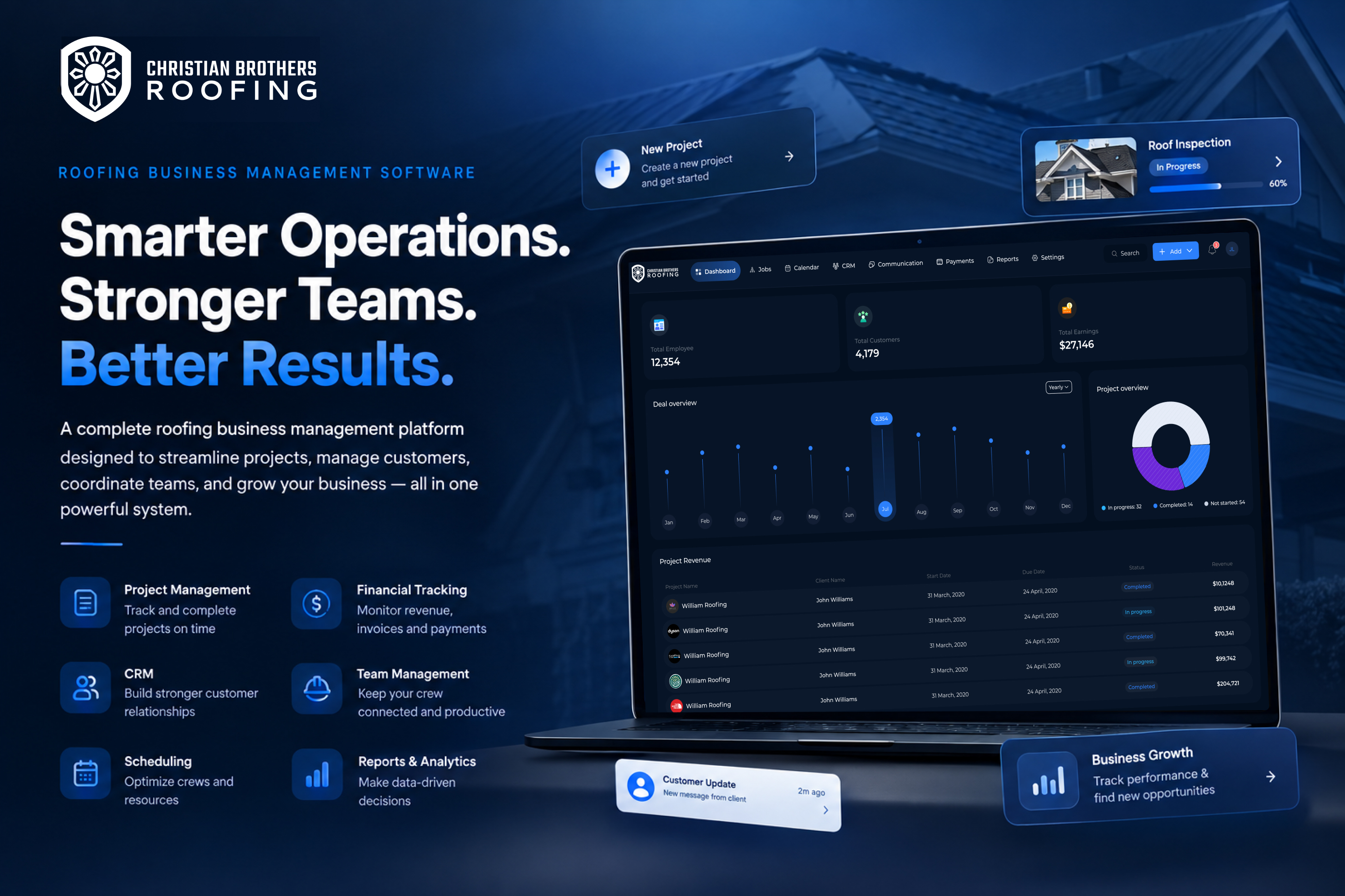
Christian Brothers Roofing was designed as a comprehensive roofing management platform that centralizes operations, improves team collaboration, streamlines project workflows, and provides real-time business visibility through an intuitive web application.
This case study explores how strategic UI/UX design transformed complex roofing operations into a user-friendly digital experience that supports productivity, operational efficiency, and long-term business growth.
Managing a roofing business involves far more than overseeing construction projects.
Companies must simultaneously manage:
Many roofing contractors still rely on multiple disconnected systems, creating operational silos that reduce efficiency and increase administrative workload.
Common challenges include:
Project managers often struggle to monitor multiple roofing projects simultaneously.
Coordinating roofing crews, subcontractors, and project timelines can become increasingly complex.
Miscommunication between office teams, project managers, and field crews often causes delays and mistakes.
Tracking invoices, payments, expenses, and profitability across multiple projects can become difficult without centralized reporting.
These operational challenges create significant opportunities for digital transformation.
Before designing the platform, extensive research was conducted to understand how roofing companies manage their day-to-day operations.
The research focused on:
The goal was to identify workflow bottlenecks, communication challenges, reporting requirements, and opportunities for automation.
Several key insights emerged:
Project managers need immediate access to project status, schedules, customer records, and financial data.
Complex software often creates resistance among teams. A clean and intuitive experience increases adoption and productivity.
Real-time dashboards help managers identify issues before they become costly problems.
These insights became the foundation for the product strategy and design process.
The primary objective was to create a centralized system capable of managing every major operational function within a roofing business.
Every feature was designed around real-world roofing workflows rather than software complexity.
One of the biggest challenges in SaaS product design is making complex workflows feel simple.
Roofing businesses require access to large amounts of information, but overwhelming users with excessive data can reduce productivity.
The platform addresses this challenge through several UX principles.
The dashboard prioritizes critical business information so users can immediately identify important tasks and project updates.
Projects, customers, schedules, reports, estimates, and financial records are organized into logical categories that reduce cognitive load.
Progress indicators and project timelines allow users to quickly understand project status without searching through multiple screens.
Reporting dashboards transform complex business data into actionable insights that support better operational decisions.
This approach creates a more efficient and user-friendly experience for every role within the organization.
Christian Brothers Roofing combines multiple operational systems into one centralized platform.
Project managers can:
A centralized project management workflow helps improve visibility and accountability across every stage of the project lifecycle.
Customer relationships are a critical driver of business growth.
The platform centralizes:
This allows teams to deliver more personalized and responsive customer experiences.
Managing field teams efficiently is essential for successful project delivery.
The system enables businesses to:
Real-time visibility helps ensure projects remain on schedule and within budget.
Financial visibility is critical for profitable operations.
The platform includes tools for:
These capabilities help business owners make informed decisions and maintain healthy cash flow.
Data is one of the most valuable assets for growing businesses.
The reporting system provides visibility into:
These insights help roofing companies identify opportunities for optimization and growth.
As SaaS products evolve, maintaining consistency becomes increasingly important.
To support long-term growth, a comprehensive design system was developed that includes:
A scalable design system accelerates development while ensuring a consistent user experience across future product updates.
Great software design directly impacts business performance.
When roofing companies use intuitive and efficient management platforms, they can:
Teams spend less time navigating software and more time completing valuable work.
Managers gain a clearer understanding of project status and operational performance.
Better customer management leads to improved communication and customer satisfaction.
Real-time reporting enables faster and more informed decision-making.
Scalable systems provide the foundation for future expansion.
The combination of strong UX strategy, operational workflows, and intuitive product design creates measurable value for both users and businesses.
Designing Christian Brothers Roofing reinforced several important product design principles.
Understanding how roofing businesses operate is essential for creating useful software.
Reducing complexity improves usability, productivity, and adoption.
Users make better decisions when information is accessible and actionable.
A strong design system enables products to grow without sacrificing user experience.
Many software platforms focus heavily on features while overlooking usability.
However, even the most powerful system can fail if users struggle to complete tasks efficiently.
Strategic UI/UX design helps:
For roofing companies, investing in user-centered software design can create significant long-term advantages.

Christian Brothers Roofing demonstrates how strategic UI/UX design can transform complex roofing operations into a streamlined digital experience. By combining project management, customer relationship management, financial tracking, team coordination, and reporting into a centralized platform, the solution empowers roofing businesses to operate more efficiently and scale with confidence.
As the roofing industry continues embracing digital transformation, companies that invest in modern Roofing Business Management Software, Roofing CRM Platforms, and user-centered SaaS solutions will be better positioned to improve productivity, strengthen customer relationships, and achieve sustainable growth.